
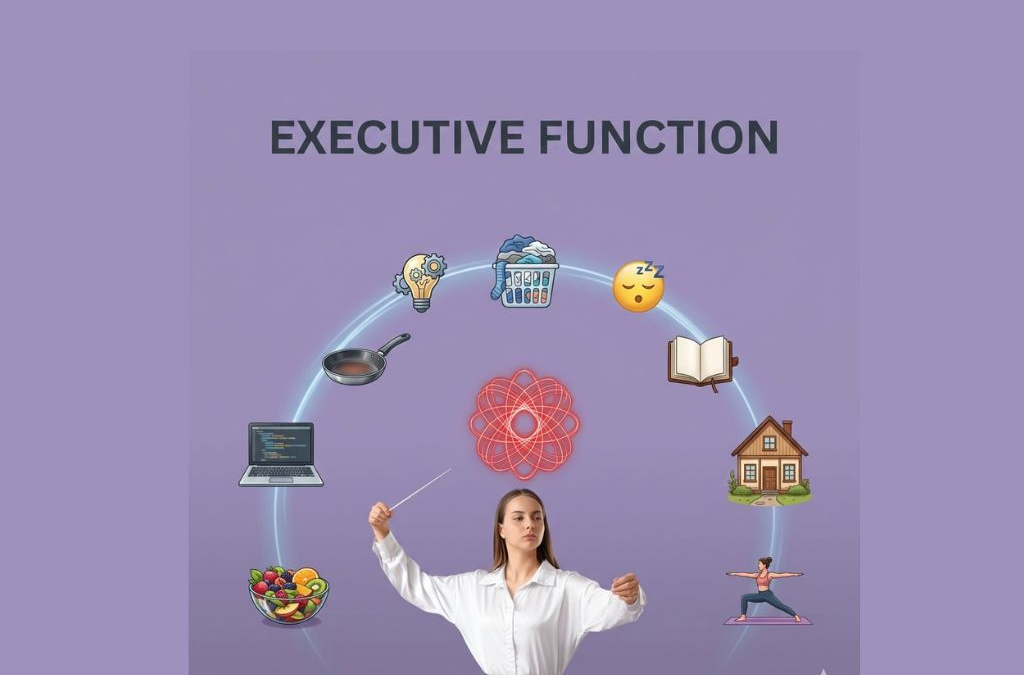
Executive Function and Executive Dysfunction: Understanding the Brain Behind Your Behavior
Let’s look at what executive function really is, what’s happening in the brain, why some people struggle more than others, and what executive dysfunction actually looks like in everyday life.
We all have an executive function system in our brains. It is part of what makes us uniquely human, allowing us to pause, reflect, plan for the future, regulate our impulses, and choose actions aligned with our values rather than simply reacting to the moment.
When it’s working well, you feel calm, focused and capable. You can plan your day, manage your emotions, prioritize what matters, and actually get stuff done.
When it’s not working well, life can feel chaotic and overwhelming — and much harder than it “should” be. Even when you’re intelligent. Even when you care. Even when you’re trying.
You see this isn’t about willpower. It’s about brain wiring.
Let’s look at what executive function really is, what’s happening in the brain, why some people struggle more than others, and what executive dysfunction looks like in everyday life.
What Is Executive Function?
Experts from Harvard University’s Centre of the Developing Child explain that “executive function refers to a set of skills. These skills underlie the capacity to plan ahead and meet goals, display self-control, follow multi-step directions even when interrupted and stay focused despite distractions.
Executive function is your brain’s management system, and includes skills that help you:
- Plan and organize
- Perceive and manage time
- Focus your attention
- Control impulses
- Hold information in mind (working memory)
- Shift between tasks (cognitive flexibility)
- Regulate emotions
- Follow through on goals
Think of it as the master operating system of your brain.
Its job is to coordinate thought, emotion, and action so you can move toward long-term goals instead of reacting to whatever feels urgent in the moment.
When it’s strong, you can:
- Break big projects into manageable steps
- Delay gratification
- Adjust when plans change
- Stay focused despite distractions
- Respond calmly under stress
- Build healthy relationships
When it’s overloaded or under-functioning, even the simple tasks of daily life can feel disproportionately hard.
The Core Skills of Executive Function
An article in the Lancet describes Executive function as “a multifaceted construct that describes higher-order cognitive processes necessary for purposeful and goal-directed behavior such as problem-solving, planning, and decision-making.” These skills can be divided into several key areas:
1. Working Memory
Think of it as being like a magic whiteboard in your mind, where you hold and use information. Example: remembering instructions while completing a task. Calculating 5 + 2 + 3.
2. Inhibitory Control
Your brain has many thoughts that are not true or that might cause you harm. Inhibitory control is the ability to pause before acting — resisting impulses and filtering distractions.
3. Cognitive Flexibility
The ability to shift perspective or adapt when circumstances change.
4. Planning and Organization
Creating steps, sequencing actions, and structuring time and materials.
5. Time Perception and Management
Accurately estimating time and how long things take and allocating time realistically.
6. Emotional Regulation
Managing feelings so they don’t derail your goals or relationships. Feelings are meant to be like clouds passing in the sky – they inform us that something is going on, then they pass.
These systems are deeply interconnected. When one is strained, the others will be impacted too.
Where Executive Function Lives in the Brain
Executive function is primarily centered in the prefrontal cortex (PFC) — the area just behind your forehead.
It acts like the conductor of an orchestra — coordinating signals from emotional and sensory centers so your behavior stays aligned with your values.
Other important players include:
The Anterior Cingulate Cortex (ACC): the brain’s “gear shifter”.
The Basal Ganglia: involved in motivation, task initiation and habit formation.
The Amygdala: your emotional alarm system, which when stress is high, can override the prefrontal cortex — which is why you might say or do things you later regret when overwhelmed. Stress literally makes it harder to think clearly.
The Neurochemistry Of Executive Function
Executive function relies on three well known neurochemicals:
- Dopamine plays a central role in motivation, reward processing, sustained attention, and task initiation. When dopamine levels are low or dysregulated, executive function can suffer — something we see clearly in ADHD, where initiating tasks and sustaining effort become disproportionately difficult.
- Norepinephrine / noradrenaline supports alertness, focus, and working memory. It helps the brain stay engaged with what matters and hold information “online” long enough to think clearly and act strategically.
- Serotonin is primarily involved in mood regulation and impulse control. When serotonin balance is disrupted, emotional reactivity can increase and self-regulation becomes harder, even when someone intellectually knows what they should do.
This is why executive struggles are not solved by “trying harder.”
The brain needs the right balance of chemistry to function efficiently.
What Is Executive Dysfunction
It is not laziness. It is not a character flaw. It is not a lack of intelligence or discipline its difficulty in regulating one or more of the executive function processes.
It often looks like:
- Chronic procrastination
- Trouble starting tasks (even important ones)
- Poor time estimation (“time blindness”)
- Emotional overreactions
- Disorganization
- Forgetting key details
- Difficulty prioritizing
- Hyperfocusing on low-priority tasks
Clients with executive function issues often explain:
“I know what I need to do. I just can’t seem to make myself do it consistently.”
That gap between intention and action is the hallmark of executive dysfunction.
Who Commonly Struggles? Causes of Executive Dysfunction
Executive function challenges are often associated with:
ADHD
Executive dysfunction is central to ADHD. Common patterns include time blindness, impulsivity, working memory challenges, task initiation problems, and emotional dysregulation.
Autism Spectrum Disorder (ASD)
Executive function profiles very widely in people with ASD. Some individuals experience cognitive inflexibility, planning challenges, and difficulty shifting attention.
Depression
Depression can reduce motivation, slow thinking, and impair working memory and decision-making. Executive dysfunction here often looks like low drive.
Anxiety Disorders
Chronic anxiety over-activates the amygdala, which decreases prefrontal efficiency. This can lead to overthinking, difficulty concentrating, and decision paralysis.
Traumatic Brain Injury
Injury to frontal regions often disrupts executive functioning.
Chronic Stress and Burnout
Even without a diagnosis, prolonged stress elevates cortisol and suppresses prefrontal cortex activity.
Under severe acute or chronic, sustained stress, you may notice:
- Poor decisions
- Increased emotional reactivity
- Planning breakdown
- Reduced mental clarity
Executive dysfunction doesn’t only happen in people with a diagnosis. Even healthy, capable people can struggle with focus, organization, and follow-through during times of stress, exhaustion, burnout, or major life changes.
How Executive Dysfunction Shows Up in Daily Life
As with many things, its impact is unique to each person. Executive function and intelligence as not directly correlated, so you can find executive dysfunction problems in a highly intelligent person. Intelligence helps you understand what to do. Executive function helps you consistently do it.
At school it might show up as forgotten assignments, struggling with big projects and poor time management.
At work a person might struggle performing repetitive, mundane tasks, working to a deadline, thoughtful decision making, difficulty prioritizing and emotional impulsivity, especially if they feel rejected or criticized (rejection sensitivity disorder (RSD)).
In relationships they may be unreliable, late and overly emotional, as well as interrupting and struggling to repair conflict.
At home they may be messy and lack routine. They may have many unfinished projects and abandoned hobbies.
Executive Dysfunction and Shame
Those who grew up with executive challenges they have heard negative feedback thousands of times. Comments life “You’re lazy”, “You’re not living up to your potential” or “If you just tried harder…” slowly but surely quietly erode self-esteem and lead to regret and shame. This can become a negative spiral which in turn makes executive function worse.
For those who once had good executive function and are now struggling the change in function can be scary and confusing. Things that were once easy are now hard. For the people who know them it can appear as flakiness or laziness.
What’s is important to recognize is that executive function is not about effort alone. It’s about brain regulation.
Understanding the neuroscience can be profoundly relieving. It shifts the story from defect to difference.
And once you understand the system, you can support it.
Can Executive Function Improve?
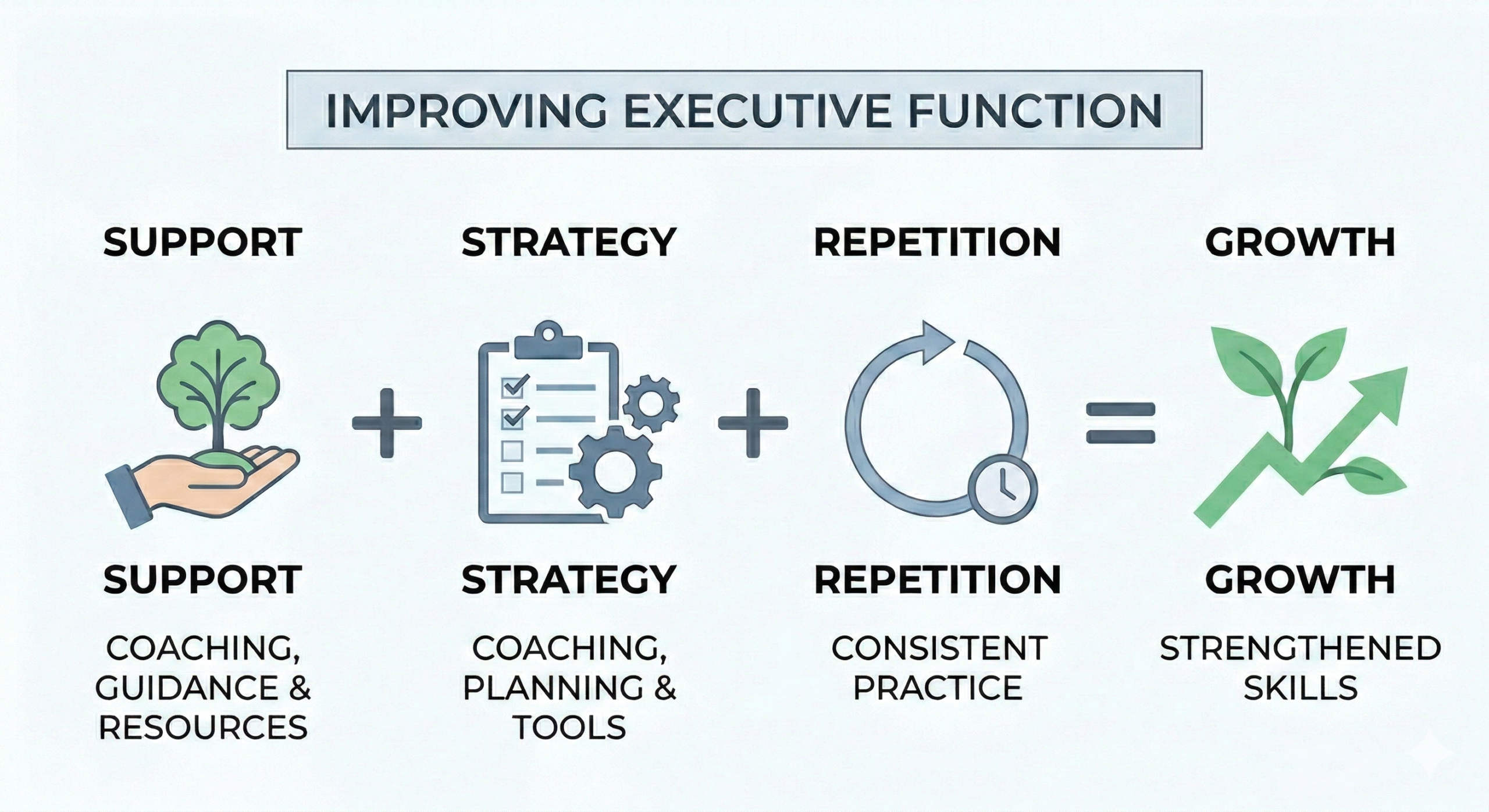
The really good news is that – Yes, it can improve!
The brain is plastic. Executive circuits can strengthen with intentional support and repetition.
Research supports interventions such as:
- Improving underlying brain health through lifestyle change: diet, exercise, and sleep. External structure and task chunking
- Coaching which can help you find strategies for overcoming deficits and provide external accountability
- Cognitive-behavioral strategies
- Stress management techniques
- Mindfulness training
- Medication prescribed by a healthcare provider can be effective for some, in certain conditions such as ADHD
Final Thoughts
Executive function is your brain’s control system — coordinating attention, emotion, motivation, and action.
When it’s balanced, life flows.
When it’s strained, even small tasks can feel overwhelming.
Executive dysfunction is not your fault, it is a neurological difference that can be understood, supported, and improved.
Awareness is the first step.
Compassionate strategy is the second. You owe it to yourself to function at a higher level so you can live the life you truly desire.
If you have ever felt capable yet inconsistent…driven yet overwhelmed…intelligent yet disorganized… Executive function may be part of your story.
And it is absolutely a story you can work with.
Wondering If You Might Have Executive Dysfunction?
If you recognize yourself in this article and you know that you could be operating at a higher level, please know that you are not broken — your brain may simply be wired differently.
I offer brain-based ADHD coaching and executive function strategy sessions for adults and professionals navigating high-performance environments.
👉 Book a discovery call
👉 Download the Executive Function Self-Assessment
Frequently Asked Questions (FAQ)
1. What is executive function in simple terms?
Executive function is your brain’s management system. It includes skills like planning, focus, impulse control, working memory, emotional regulation, and time management. These skills help you move toward long-term goals instead of reacting to the moment.
2. What causes executive dysfunction?
Executive dysfunction is usually linked to differences in the prefrontal cortex and its connections with the basal ganglia, anterior cingulate cortex, and amygdala. It can be influenced by ADHD, chronic stress, trauma, sleep deprivation, depression, or dopamine and norepinephrine imbalances.
3. Is executive dysfunction the same as ADHD?
No. ADHD is a neurodevelopmental condition that often includes executive dysfunction, but executive dysfunction can occur without ADHD. Many conditions — including anxiety, depression, brain injury, and burnout — can impair executive function.
4. What are signs of executive dysfunction in adults?
Common signs include chronic procrastination, difficulty starting tasks, poor time management, emotional overwhelm, forgetfulness, disorganization, impulsive decisions, and trouble following through — even when you care about the outcome.
5. How does dopamine affect executive function?
Dopamine helps regulate motivation, attention, and task initiation. When dopamine levels are too low or poorly regulated, it becomes harder to start tasks, sustain focus, and feel rewarded by progress. Balanced dopamine supports drive and goal-directed behavior.
6. Can executive function be improved?
Yes. Executive function is trainable due to neuroplasticity. Exercise, sleep optimization, stress regulation, structured routines, cognitive behavioral strategies, proper nutrition, and in some cases medication can significantly improve executive function skills.
7. Why does stress make it harder to think clearly?
High stress activates the amygdala (the brain’s threat system) and suppresses activity in the prefrontal cortex — the area responsible for planning, impulse control, and rational thinking. This is why you may feel reactive, scattered, or overwhelmed when stressed.
To Your Brain Health and Your Power,
Dr. Leonaura Rhodes
Chief Life Designer
P.S. This is the first time sending via a new email provider — please let me know if there are any problems.
Article Archive: https://www.drleonaurarhodes.com/articles/
https://www.linkedin.com/in/leonaurarhodes/
https://www.facebook.com/drleonaurarhodes
https://www.instagram.com/leonaurarhodes/
Youtube
https://www.youtube.com/channel/UC2IIJj_hnHZJO8BwcKPqInQ
TikTok
https://www.tiktok.com/@drleonaura