
Neurodiversity describes the natural variation in how human brains think, learn, process information, and experience the world—recognizing that there is no single “right” way for a brain to function. It’s a social framework, not a medical label, and highlights that around one in five people are neurodivergent, often navigating systems that were never designed with their cognitive differences in mind.
Read my article “What is Neurodiversity: A Brain-Based Perspective” to learn more about defining neurodiversity.
Top 8 Neurodiversity Diagnoses: Common Neurodivergent Conditions
- Autism Spectrum Disorder (ASD)
- Attention-Deficit/Hyperactivity Disorder (ADHD)
- Dyslexia
- Dyspraxia (Developmental Coordination Disorder)
- Dyscalculia
- Tourette Syndrome
- Obsessive-Compulsive Disorder (OCD)
- Intellectual Disability
Every person with neurodiversity is unique and many describe symptoms across multiple diagnoses. For example:
- Autism + ADHD: ~ 50–70% of autistic individuals also meet criteria for ADHD.
- Dyslexia + ADHD: ~ 25–40% co-occurrence (some studies report up to 50% in clinical samples).
- Dyspraxia (DCD) + ADHD: ~ 30–50% co-occurrence.
If you are seeking a diagnosis the actual disorder name may matter, but otherwise for most non-clinicians it is often more helpful to think in terms of meeting the needs of the individual and in order to do that to identify differences that affect the ability to function (in this “neurotypical” world). These fall into 8 domains: attention, executive functioning, social processing, understanding and using language, sensory processing, motor planning and coordination, thinking or cognitive style and emotions and energy regulation.
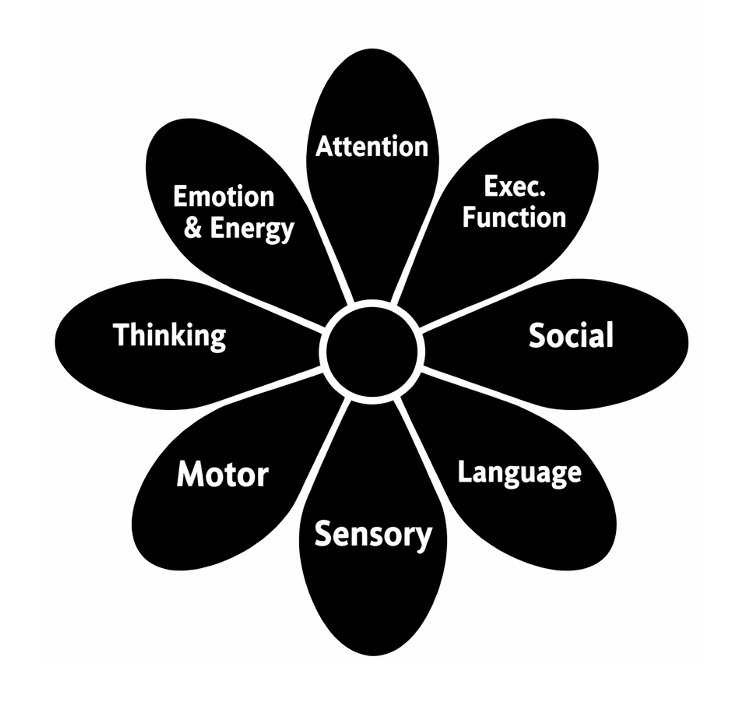
Domains of Neurodiversity: Categories of symptoms
Neurodiversity Symptoms Categorized
This guide focuses on shared neurodevelopmental dimensions rather than diagnostic labels. Each section shows how the same behaviours can look one way externally while reflecting very different internal experiences.
How Does Neurodiversity Affect Attention and Focus?
Attention differences are one of the most recognized aspects of neurodiversity, but they don’t always mean “can’t focus.” Many neurodivergent individuals experience variable attention — from distractibility to intense hyperfocus — depending on interest, stimulation, and cognitive load.
- What others see
- Easily distracted or inconsistent focus
- Difficulty staying engaged with routine tasks
- Appearing to lose track of conversations or meetings
- Intense focus on some tasks but not others
- Forgetting details or instructions
- What the neurodiverse individual may be experiencing
- Attention that is strongly driven by interest or urgency
- Difficulty filtering competing information
- Sudden shifts between under-focus and deep focus
- Mental effort required to maintain concentration
- What’s happening internally
- The brain is constantly prioritizing multiple inputs.
- Focus regulation relies heavily on stimulation, meaning, or novelty.
- Cognitive resources may be depleted quickly when tasks feel repetitive or low in engagement.
What Are Executive Function Challenges in Neurodivergent Individuals?
Executive functions are the brain’s management system, responsible for planning, organization, time awareness, and follow-through. In neurodivergent individuals, these skills may develop unevenly, creating real-world challenges despite high intelligence or capability.
- What others see
- Procrastination or delayed task initiation
- Disorganization or missed deadlines
- Difficulty prioritizing tasks
- Trouble following multi-step processes
- Appearing overwhelmed by workload
- What the neurodiverse individual may be experiencing
- Difficulty deciding where to begin
- Trouble holding multiple priorities in mind simultaneously
- Feeling stuck despite motivation
- High mental effort required for planning
- What’s happening internally
- Executive systems responsible for sequencing, planning, and initiation are working less automatically.
- Cognitive overload occurs when too many choices compete for attention.
- Significant mental energy is used just to organize next steps.
How Does Neurodiversity Influence Social Processing and Social Cues?
Social processing differences are not a lack of empathy or interest, but often a difference in how social information is interpreted and expressed. Neurodivergent individuals may read social cues differently, communicate more directly, or experience social interactions as cognitively demanding.
- What others see
- Quietness, bluntness, or social awkwardness
- Missing social cues or conversational timing
- Preference for direct communication
- Limited participation in small talk
- Appearing distant or overly formal
- What the neurodiverse individual may be experiencing
- Actively decoding social rules in real time
- Uncertainty about unspoken expectations
- Social interaction requiring conscious effort
- Fear of misunderstanding others
- What’s happening internally
- Social information may be processed analytically rather than intuitively.
- Extra processing time is needed to interpret tone, facial expressions, and intent.
- Social engagement can drain cognitive resources quickly.
How Do Neurodivergent Brains Understand and Use Language Differently?
Language differences in neurodiversity can affect both understanding and expression, ranging from literal interpretation to rapid idea generation. Communication styles may be precise, visual, nonlinear, or deeply associative rather than conventionally structured.
- What others see
- Slower verbal responses
- Difficulty explaining ideas clearly under pressure
- Word-finding pauses
- Overly detailed explanations
- Challenges following complex verbal instructions
- What the neurodiverse individual may be experiencing
- Translating thoughts into spoken language step by step
- Working to organize ideas while listening
- Needing extra time to process verbal information
- What’s happening internally
- Language comprehension and expression may require additional processing time.
- Working memory is managing incoming information and response planning simultaneously.
- Precision in language may be prioritized over speed.
What Is Sensory Processing in Neurodiversity — and Why Does It Matter?
Sensory processing refers to how the brain receives, filters, and responds to input like sound, light, touch, taste, and movement. Neurodivergent individuals may experience sensory input as amplified, muted, or unpredictable, which can significantly impact daily functioning.
- What others see
- Appearing overwhelmed or easily distracted
- Needing quiet spaces or breaks
- Irritability in busy environments
- Avoidance of noise, bright lights, or crowds
- Difficulty concentrating in open offices
- What the neurodiverse individual may be experiencing
- Sensory input feeling intense or intrusive, sometimes leading to “sensory overwhelm”
- Difficulty filtering background stimulation
- Mental fatigue from constant sensory processing
- What’s happening internally
- Sensory filtering mechanisms may be less automatic.
- The nervous system is processing more environmental information at once.
- Cognitive bandwidth is reduced when sensory demand is high.
How Are Motor Planning and Coordination Affected in Neurodivergent People?
Motor planning involves the brain’s ability to coordinate physical movement smoothly and efficiently. Differences in this area can affect handwriting, posture, sports, fine motor skills, or even the physical effort required for everyday tasks.
- What others see
- Clumsiness or awkward movements
- Slow completion of physical tasks
- Messy handwriting or difficulty with fine motor tasks
- Trouble learning new physical routines
- What the neurodiverse individual may be experiencing
- Extra concentration needed for coordination
- Difficulty translating intention into movement
- Physical fatigue from seemingly simple tasks
- What’s happening internally
- Motor planning requires conscious processing rather than automatic execution.
- Multiple brain systems must coordinate movement step by step.
- Physical tasks may consume more energy than expected.
What Is a Neurodivergent Thinking Style or Cognitive Profile?
Neurodivergent thinking styles often include pattern recognition, deep focus on niche interests, big-picture systems thinking, or highly creative problem-solving. These cognitive differences can be powerful strengths when understood and supported appropriately.
- What others see
- Overthinking or going off on tangents
- Unconventional ideas or problem-solving approaches
- Difficulty giving quick answers
- Intense focus on specific topics
- Big-picture thinking with missed details (or vice versa)
- What the neurodiverse individual may be experiencing
- Rapid association-making between ideas
- Deep analytical or pattern-based thinking
- Difficulty simplifying complex thoughts quickly
- What’s happening internally
- Information may be processed non-linearly or through patterns.
- Multiple mental pathways are active simultaneously.
- Depth of processing may prioritize accuracy over speed.
How Does Neurodiversity Impact Emotions and Energy Regulation?
Emotional regulation and energy management are closely tied to nervous system functioning. Many neurodivergent individuals experience emotions intensely and may have fluctuating energy levels that don’t align with conventional expectations of consistency.
- What others see
- Strong emotional reactions
- Fluctuating energy levels
- Appearing overly sensitive or stressed
- Periods of high performance followed by exhaustion
- Need for recovery time after social or cognitive demands
- What the neurodiverse individual may be experiencing
- High internal pressure to perform well
- Emotional responses intensified by cognitive overload
- Fatigue from masking or adapting to expectations
- What’s happening internally
- Emotional regulation systems may be working alongside high cognitive demand.
- Sustained adaptation to environments not designed for their processing style can lead to burnout.
- Energy is consumed by constant self-monitoring and adjustment.
Related resources & articles:
Neurodiversity at work webinar for CEOs and HR professionals
ARTICLES
What is Neurodiversity Coaching?
Distracted and distractable? Is it ADHD or something else?
7 Things That Deplete Your Attention
Prefer video? Check out my Youtube channel
FAQ
- Is neurodiversity the same as a diagnosis?
No, neurodiversity is not a medical diagnosis. It is a social and conceptual framework that recognizes natural variation in how human brains function. Clinical diagnoses like ADHD, autism, or dyslexia describe specific patterns of traits, while neurodiversity describes the broader idea that brain differences are part of normal human variation.
- What does it mean to be neurodivergent?
Being neurodivergent means your brain processes information, attention, language, emotion, or sensory input differently from what is considered neurotypical. These differences may align with conditions such as ADHD, autism, dyslexia, or other neurodevelopmental profiles. Around one in five people are estimated to be neurodivergent, often navigating systems not designed for their cognitive style.
- Can someone be both autistic and have ADHD?
Yes, many individuals meet criteria for both autism and ADHD. Research suggests that approximately 50–70% of autistic individuals also show significant ADHD traits or meet full diagnostic criteria. Co-occurring neurodevelopmental conditions are common, which is why understanding shared traits across domains can be more helpful than focusing on a single label.
- How do I know if I might be neurodivergent?
You may consider exploring neurodivergence if you notice consistent differences in attention, executive functioning, social processing, language, sensory experiences, motor coordination, thinking style, or emotional regulation. Patterns that have been present since childhood and affect daily functioning are particularly important. A qualified professional can provide a formal assessment if a diagnosis is needed for support or accommodations.
- Why does neurodiversity matter in schools and workplaces?
Neurodiversity matters because traditional systems are often built around a narrow definition of how people should think, learn, and work. When environments fail to accommodate cognitive differences, it can lead to stress, burnout, underperformance, or exclusion. Recognizing neurodiversity allows schools and workplaces to support strengths, reduce unnecessary barriers, and improve outcomes for everyone.
To Your Brain Health and Your Power,
Dr. Leonaura Rhodes
Chief Life Designer
P.S. This is the first time sending via a new email provider — please let me know if there are any problems.
Article Archive: https://www.drleonaurarhodes.com/articles/
https://www.linkedin.com/in/leonaurarhodes/
https://www.facebook.com/drleonaurarhodes
https://www.instagram.com/leonaurarhodes/
Youtube
https://www.youtube.com/channel/UC2IIJj_hnHZJO8BwcKPqInQ
TikTok
https://www.tiktok.com/@drleonaura