
Brain Hack: Optimize Your Working Memory
Do you ever find yourself forgetting where you put your keys, being unable to follow verbal directions or losing track of what someone’s saying in the middle of a long monologue? If the answer is “YES” it could be that your “working memory” is struggling.
Every day in this crazy fast-paced world, our brains are constantly bombarded with information. Whether you are managing professional projects, navigating school work, or simply trying to stay organized in your personal life, your working memory is the “management system” that helps you succeed.
So how can you “hack” working memory? By combining insights from neuroscience and executive functioning research, you can super charge your memory and start optimizing your brain for peak performance.
What Is Working Memory?
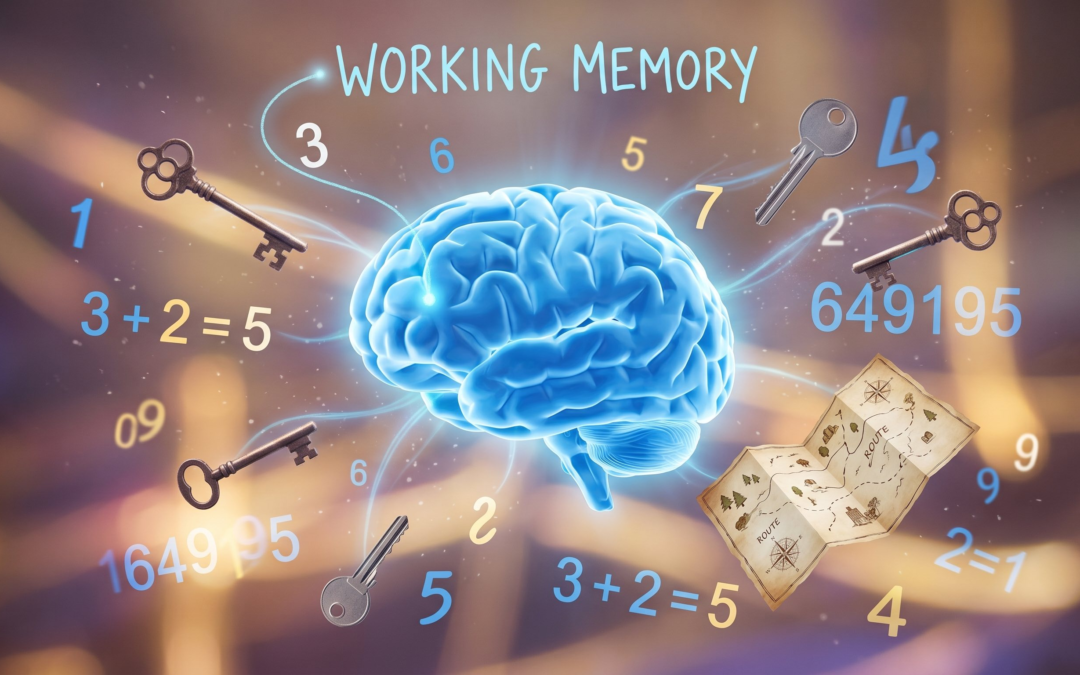
Working memory is one of the “executive functions” of the brain. Amishi Jha in her fascinating book Peak Mind explains that working memory functions are the brain’s “mental workspace,” or mental white board enabling you to hold and manipulate information for a short time e.g. if you wanted to calculate 3 + 2 + 5, you’d write the numbers on the whiteboard while you did the calculation. It’s an amazing system but there are two major flaws. First, it’s as if the ink that the information is written in is magical, it disappears over time, replaced by new or more interesting information, making it fragile. Second, it has a very limited capacity so if you overload working memory it will glitch.
Signs Of Working Memory Problems
When your working memory is overloaded you may experience:
- The “Doorway Effect”: Forgetting why you started a task as soon as you shift environments… the “what did I come to the kitchen for?” effect.
- Task-Initiation Failure: Feeling overwhelmed by complex, multi-step projects, can lead to failure to initiate the task at all.
- Difficulty Following Directions: Struggling to hold sequential instructions in mind while trying to execute them.
- Emotional Volatility: Reduced cognitive “bandwidth” makes small stresses feel unmanageable.
The Bottleneck: Why Working Memory Challenges Occur
Because your working memory has finite capacity, it is incredibly easy to overload it. When you attempt to juggle too many variables, hold onto complex instructions, or regulate strong emotions while trying to work, the “system” experiences a bottleneck.
When your working memory is crowded with distraction, stress, or incomplete tasks, your ability to think clearly evaporates. This is not a failure of intelligence; it is a limit of biology.
So, Who Struggles with Working Memory?
Working memory challenges are common and can affect anyone, though some populations are more likely to struggle:
- Individuals with ADHD: ADHD often involves impairment in executive function: the cognitive processes required for planning, organizing, and maintaining working memory. The brain struggles to “gate-keep” attention and working memory, meaning irrelevant distractions are treated with the same importance as the task at hand, quickly filling up the mental workspace.
- The Chronically Stressed: Stress acts as a “mind-wandering” trigger. When you are under high stress, your brain prioritizes internal threats over external tasks, effectively hijacking your working memory capacity.
- Those Experiencing Cognitive Decline: Normal aging or neurodegenerative conditions can reduce the speed of processing and the efficiency of the neural networks supporting executive function, making it harder to hold multiple pieces of information simultaneously.
- The “Always-On” Professional: Work overload and constant context-switching (moving between emails, calls, and projects) keep the working memory in a state of “constant partial attention,” preventing the deep focus needed for high-quality output.
- The Phone Addict: Our brains were not designed to deal with our hyper-connected world, where we are constantly bombarded with digital notifications and the temptation to switch to a more rewarding app. This constant influx crowds and weakens our attention and working memory.
Dopamine and Working Memory
Dopamine acts as the essential neurochemical “tuner” for the prefrontal cortex. with its effect following an “Inverted U-Shape” curve that requires a “Goldilocks” balance to maintain a functioning mental workspace. At low levels, the prefrontal cortex lacks the activity needed for sustained attention, which is often characteristic of ADHD; at optimal levels, dopamine effectively filters out cognitive noise, allowing for sharp and resilient working memory. However, excessive dopamine—often triggered by high stress or hyper-arousal—floods the neural circuits, causing the prefrontal cortex to “go offline” and leading to the temporary memory lapses and loss of focus associated with being overwhelmed.
How to Train Your Working Memory
The good news is that working memory is not a fixed trait; it is a trainable skill. Through the principle of neuroplasticity—the brain’s ability to rewire itself—consistent cognitive engagement can strengthen these neural pathways.
While “brain games” (like Bridge or chess) are popular, their value lies in the process of holding and manipulating information. When you play games that require you to track multiple moving variables, remember patterns, or switch strategies rapidly, you are effectively “lifting weights” with your attention. The key is not the game itself, but the intentional, repetitive practice of engaging your executive functions to keep that mental workspace clear and active.
How to Support Your Working Memory
You don’t need to be neurodivergent or elderly to benefit from these “brain hacks” for better working memory:
- Externalize Often: Stop asking your brain to do more of what it’s struggling with. Offload tasks, instructions, and ideas to a physical list or a digital tool. Keep your mental workspace clear for processing, not storage.
- Strengthen the “Attention Muscle”: Amishi Jha’s research shows that engaging in 10–12 minutes of daily mindfulness meditation improved focus and working memory. This trains your brain to notice when it drifts and return to center, directly strengthening the neural networks responsible for working memory.
- Biological Priming: Use aerobic exercise to increase BDNF (brain-derived neurotrophic factor). After deep work, engage in a brief, intense physical burst—like 30 seconds of burpees—to reset your nervous system and “stamp” your progress.
- Improve your brain health: If you want any of your cognitive functions to work well its important to keep your brain healthy. My top 6 brain health strategies are: brain healthy diet, regular exercise, manage stress and your emotions, positive social interactions, good sleep and a healthy environment.
- Remember: Working memory isn’t a measure of your intelligence; it’s a finite system. Manage the input, and you manage the output.
Working memory affects every aspect of your life. When it is struggling life is harder, when it is efficient things run smoother. The good news is that even if it is struggling because you’ve overloaded or you have ADHD or cognitive decline there are things you can do to train it and give it a helping hand.
Frequently Asked Questions (Q&A)
Q: Is working memory the same as IQ? A: No. IQ is a measure of cognitive ability, whereas working memory is the “processing power” you have available in the moment. You can have high cognitive ability but a “cluttered” mental workspace, which prevents you from demonstrating your full potential.
Q: Can I increase the capacity of my working memory? A: While the physical capacity of the brain is somewhat fixed, you can improve your functional capacity. By reducing stress, minimizing multitasking, using external tools to offload data and brain training, you allow your brain to use its available capacity much more efficiently.
Q: Why does my ADHD make it so hard to follow multi-step instructions? A: That is the hallmark of an executive function challenge. Your working memory has difficulty holding onto the first step while you attempt to initiate the second. The best “hack” here is to externalize—break the multi-step instruction into a physical checklist that you can look at, step-by-step.
Resources for Further Learning
- “Peak Mind” by Amishi Jha: The definitive guide to understanding how attention works and how to train your mind to focus.
- “Good Anxiety” by Wendy Suzuki: Explores how to harness the energy of anxiety to improve cognitive function rather than letting it distract you.
- Huberman Lab Podcast: Look for episodes on “Learning and Memory” and “Executive Function” for deep dives into the neurobiology of focus.
To Your Brain Health and Your Power,
Dr. Leonaura Rhodes
Chief Life Designer
P.S. This is the first time sending via a new email provider — please let me know if there are any problems.
Article Archive: https://www.drleonaurarhodes.com/articles/
https://www.linkedin.com/in/leonaurarhodes/
https://www.facebook.com/drleonaurarhodes
https://www.instagram.com/leonaurarhodes/
Youtube
https://www.youtube.com/channel/UC2IIJj_hnHZJO8BwcKPqInQ
TikTok
https://www.tiktok.com/@drleonaura